Yew Alley walk
The Hound of the BaskervillesYew Alley walk is a straight, enclosed path at Baskerville Hall whose halfway gate opens onto the moor. Sir Charles Baskerville walked there every night before bed; on the night he died, the path preserved the route of his last movements and the unresolved signs that drove the inquiry. It is both a precisely described estate feature and the threshold where a familiar routine becomes entangled with fear, folklore, and suspected crime.
Layout and Setting
Two dense yew hedges, each twelve feet high, border the walk and make it impassable to either side. The central path is about eight feet across, with a strip of grass roughly six feet wide between the gravel walk and each hedge. The high green walls give the route a tunnel-like enclosure, directing movement toward its far end rather than allowing an easy escape sideways.
Halfway along, a white wooden gate with a latch leads onto the open moor. At the far end stands an old, dilapidated summer-house. The contrast between the narrow, ordered path and the wide ground beyond the gate makes the crossing a conspicuous point in the route: a person walking there passes from the shelter of the estate’s hedges toward the exposed moor.
Sir Charles’s Final Walk
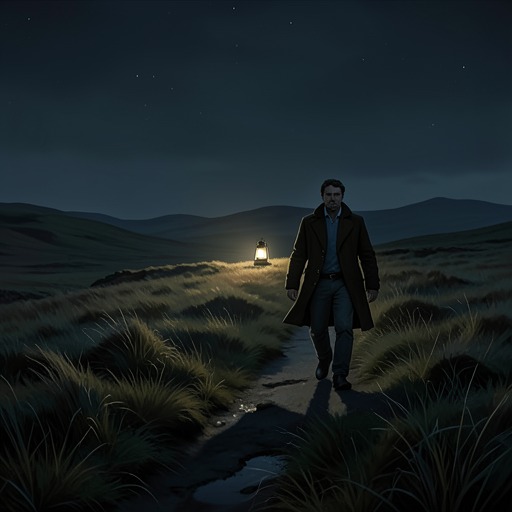
The path was part of Sir Charles Baskerville’s established nightly habit. On the evening before his planned departure for London, he went out as usual, smoking a cigar. When he had not returned by midnight, Barrymore found the hall door still open and went to look for him. Because the day had been wet, Sir Charles’s footprints could be followed along Yew Alley to the far end, where his body was found.
The gate became the crucial point in the reconstruction. The tracks suggested that Sir Charles had stopped there for a time; beyond it, his footprints changed, appearing to show that he walked on his toes. During a later visit, Dr. James Mortimer showed the spot to Sir Henry Baskerville and Dr. Watson, identifying the cigar ash by the gate and retracing the circumstances of that last walk. The route thus offered more than a location for the discovery: its sequence of footprints made the passage from ordinary habit to unexplained alarm legible, while leaving the cause uncertain.
Evidence and Investigation
Dr. James Mortimer reached Baskerville Hall soon after Sir Charles’s death and checked the trail himself. He confirmed the footprints down the walk, the apparent pause at the moor gate, and the change in their shape beyond it. He also examined the ground around the body. Although Barrymore had said at the inquest that there were no other traces, Mortimer had noticed fresh, clear marks some distance away. The discrepancy made the scene’s evidence incomplete rather than straightforwardly settled.
The physical details supported competing readings. The inquest attributed the death to natural causes, consistent with Sir Charles’s longstanding heart condition, and found no physical injury. Yet the altered footprints, the pause at the gate, and the additional tracks remained troubling details. Dr. Watson later stood in the walk and imagined Sir Charles fleeing from something he had seen beyond the gate, but recognized that the scene alone could not establish whether the feared presence was an animal, a supernatural hound, or a human agent.
Folklore and Narrative Significance
Yew Alley’s place in the mystery draws force from its proximity to the moor and from the Baskerville family’s inherited warnings about crossing that ground in darkness. Reports of a huge, luminous creature had already strengthened local belief in the family legend; the enclosed walk gave that broad, spectral fear a specific route and a point of entry into Sir Charles’s daily life. Its familiar use as a path made the night’s events more unsettling: the danger appeared not in a remote ruin but at the edge of a routine walk from home.
The later explanation connects the apparent supernatural threat to a deliberately staged deception. Sherlock Holmes identified luminous paste used to make the hound seem spectral and explained that the device drew on the family legend to frighten Sir Charles. Yew Alley therefore anchors the shift from rumor to investigation: its gate, footprints, and habitual route are concrete clues, while the open moor beyond remains the space onto which fear and the legend had been projected.